Study smarter, not harder.
Have you ever felt that your friends pick up on topics way faster than you do? Even when you use the same strategy that they swear works wonders. Have you ever held the same flashcards they use and still have no clue what the subject is about?
Well, you aren’t alone.
They say there’s a reason why our fingers aren’t the same — they serve the same purpose but perform different functions. Similarly, while you and your friend may study the same subject, perhaps the way you absorb knowledge is different.
Don’t worry, we’ve got your back!
Study methods can be broken down into many categories. Here are five study methods that may work for you:
Active learning: Engage your mind

Active recall is when you continuously test yourself to pull the information from your memory by constantly quizzing yourself or practicing questions. Studies have shown that using this method helps you retain more information and strengthen memory, making it one of the most effective study methods.
Some active recall methods include:
- Flashcards: Write down key points on one side and answers on the other.
- Practice questions: Use past exams or textbook problems to self-test.
- Teach it: Also known as the Feynman technique, is when you explain the concept to a friend, family member or even your plushie!
Passive learning: Slow and steady

Sometimes, you just want to sit back and absorb the information. If that’s the case, then passive learning is best for you. This could be reading the text, watching a pre-recorded lecture or listening to your friend teach while they use the Feynman method.
Try these techniques:
- Elaboration: Read more about the concepts in detail to understand them.
- Listening to the audio versions of the textbook.
- Watching YouTube videos on the topics (maybe at 2x speed if it’s the night before an exam).
Visualization: Organize your mind

If you are a visual learner or love getting creative with the course material, this is for you. Visualization is a study technique that includes turning your goals and notes into something you can see.
Try these:
- Mind maps: Draw diagrams that connect the big idea. Create branches for different topics and see how they are interconnected.
- Vision boards: Create a board that reminds you why you’re studying. Dream job, graduation, travel goals — you name it.
- Interleaving: Switch gears and mix topics when studying so your brain doesn’t burn out after studying the same concept.
Collaborative: Teamwork makes grades work
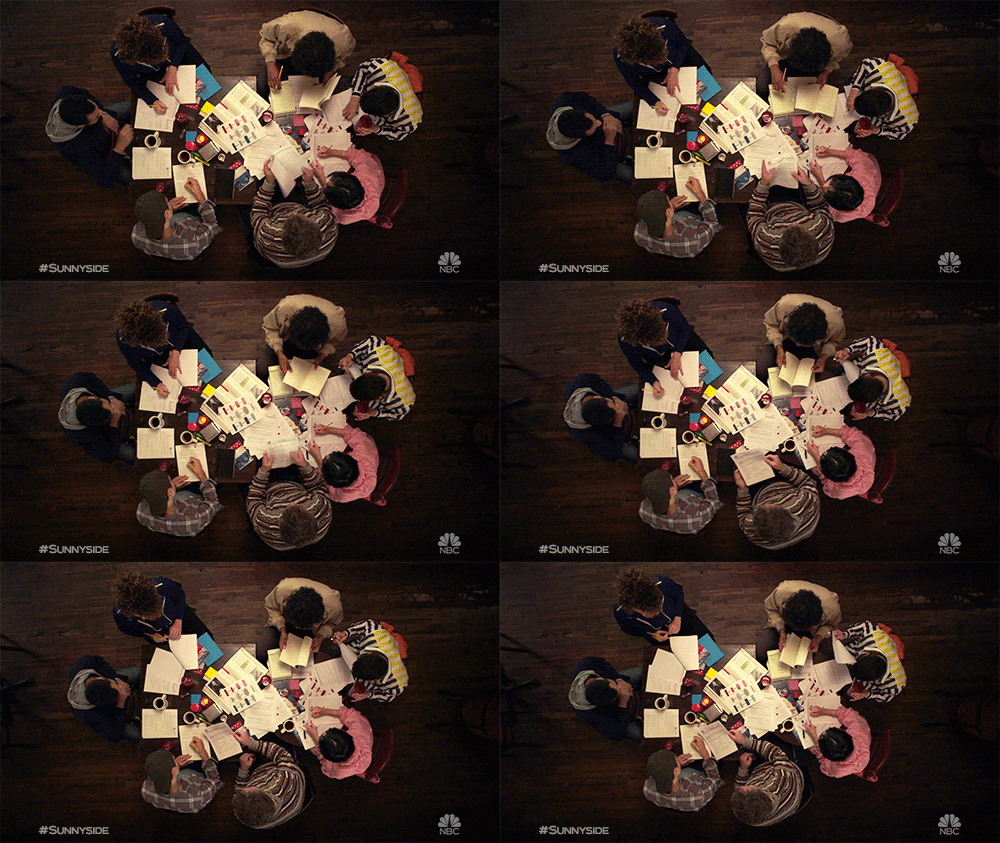
Remember that time when you decided to do a study group with your friends? And when someone explains a topic so well, everything finally makes sense? That’s what we call collaborative learning.
It’s the technique where someone excels in academics when they study with people rather than by themselves.
Try these:
- Think-pair-share: Discuss topics in pairs, then share what you learned with the group.
- Study group: Meet up weekly with friends to quiz each other or review tough topics.
- Jigsaw method: Everyone studies one topic they are assigned, then teaches it to the rest (like piecing a puzzle).
Time management: Study smarter, not longer

Let’s be real, half the battle with studying is just getting started. Time management methods can help break down large tasks into smaller, more easily doable ones while helping you stay focused and less stressed during the exam season.
Try these techniques:
- Pomodoro method: Study for 25 minutes and then give yourself a five-minute break. Then repeat (Use websites or apps to help you keep track of your time).
- Time block method: Schedule your day as soon as you wake up. Assign yourself a task to do every hour — yes, even Netflix time counts.
- Eat that frog technique: Do the hardest task first and the rest of your day will feel like a breeze.
Finding your method

There is no one-size-fits-all method to study. The best method is the one that feels natural to you. Experiment, mix and match and find out what helps you stay consistent, because once you do, studying stops being less of a chore and starts feeling more of a secret superpower.
Still not sure what method may work for you?
Take a quick quiz and find out!
Maybe by the end you’ll actually find studying to be kind of fun!
Feature image courtesy of Iewek Gnos via Unsplash.
What’s new in style? Check out IGNITE Street Styles trendsetter, dream maker!
Follow us on YouTube, Instagram and TikTok for all things student life.